AI Hype vs. Reality: 6 Questions to Ask Before You Believe an AI Headline

Almost every AI headline sounds exciting, which is exactly why it pays to slow down. A few simple questions can tell you whether a claim is solid, partly true or just marketing. You can run through them in about a minute.
- Who is saying this?A company selling the product is not a neutral source.
- What’s the evidence?Look for a test, a study or a demo you can inspect, not just a claim.
- Compared to what?“Faster” or “better” than what, exactly?
- Who benefits if I believe it?Follow the incentives: funding, sales or clicks.
- Can I try it myself?A 10-minute test beats ten opinions.
- What’s left out?Limits, costs and failure cases are often missing.
How hype usually shows up
- Absolute words like “every”, “always” or “replaces”.
- One demo presented as proof.
- Numbers without a comparison, such as “40% better” with no baseline.
- Quotes only from people who sell the product.
- Urgency, such as “you will be left behind”.
Hype is not the same as lying
Many exciting claims are partly true. A tool may really be better at one task while the headline suggests it is better at everything. Your goal is not to dismiss news but to size each claim correctly.
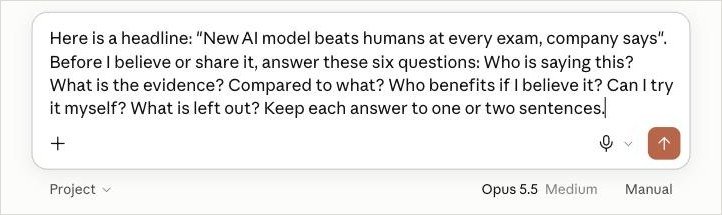
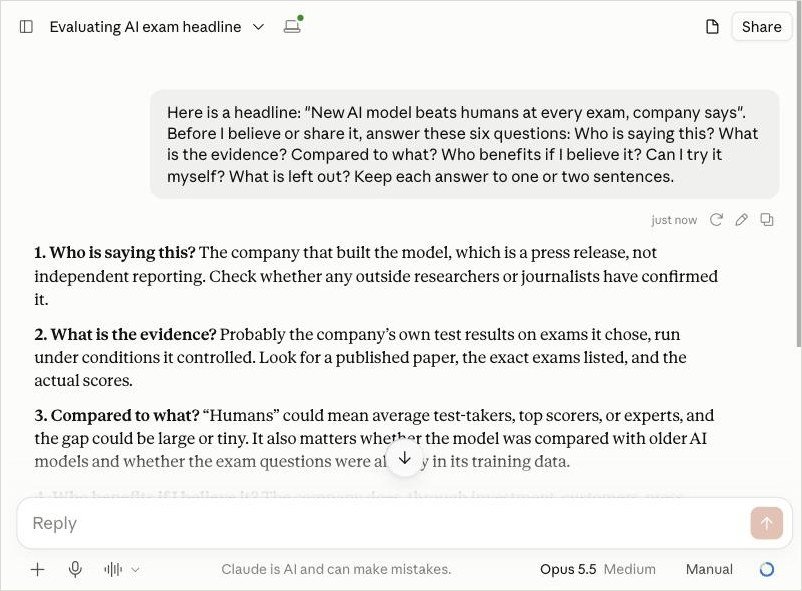
Example: running the six questions
How I tested this: I ran this prompt in Claude in October 2026, and the screenshots below come from that run. AI answers vary, so your result may look a little different.
Common mistakes
- Dismissing everything. Constant cynicism is also a bias and makes you miss real progress.
- Believing something because it is repeated. Many outlets copy the same press release.
- Using only AI to check AI. Confirm important facts with independent sources.
Your next step
Next time a headline catches your eye, run the six questions and finish with one sentence: “interesting, not proven” or “well supported”. It builds a habit that protects you and anyone you share things with.