How to Build an AI Portfolio With No Experience: A 30-Day Plan

Quick summaryNo experience? Build proof. Three small projects in 30 days is enough to start applying.
You do not need a job in AI to start building proof that you can work with it. A small portfolio of real projects shows employers and clients what you can do, and it is the fastest way to move from “interested” to “hired”.
- Week 1: Choose your lanePick one area, like writing, data or automation. Save 5 job listings and note the skills they ask for.
- Week 2: Project oneSolve a small real problem, for example automate a weekly report.
- Week 3: Projects two and threeMake one explainer guide and one before/after case study.
- Week 4: Publish and applyPut everything on one simple page, then apply to roles or freelance gigs with the link.
What a good portfolio project looks like
- It solves a real problem, even a small one.
- It shows a before and an after.
- It explains your process in plain language.
- It is honest about limits and what you would improve.
Where to put it
A simple one-page website, a public document or a shared folder with a short description is enough. What matters is that it is easy to open and that you can put the link on your CV and in applications.
See it in action
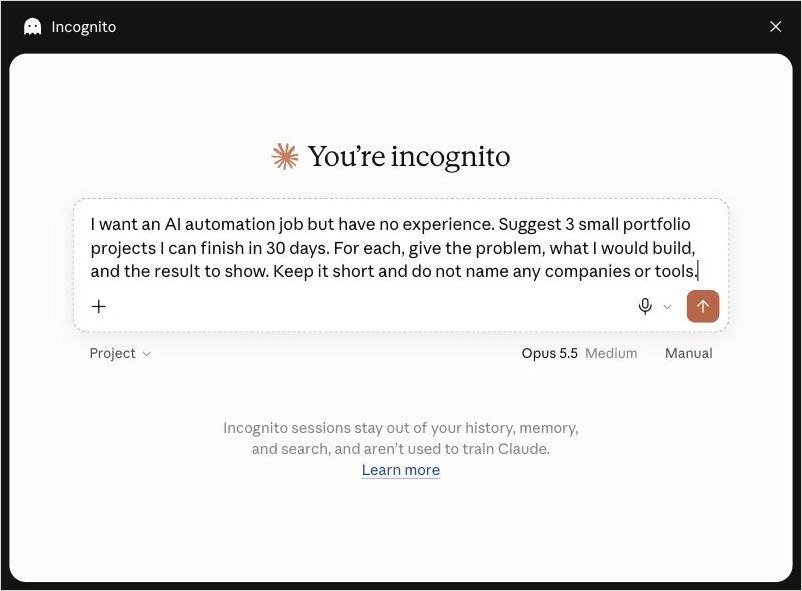
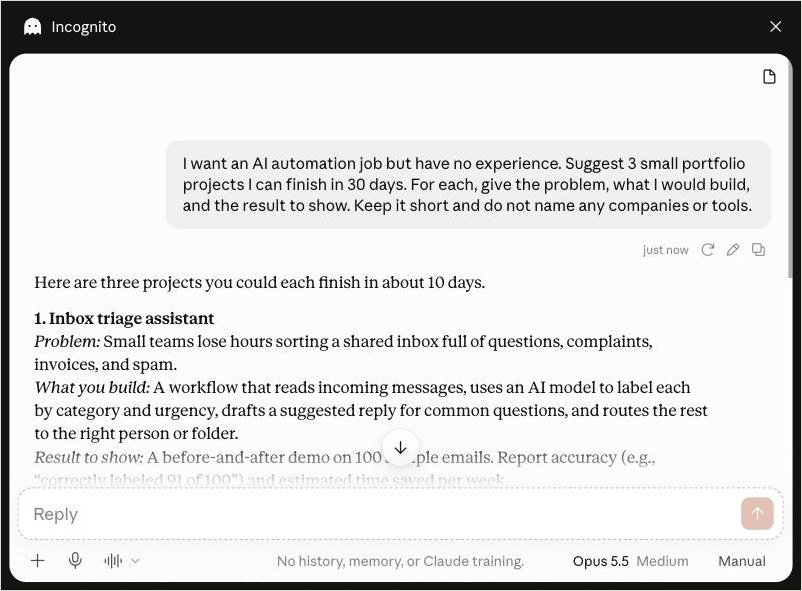
Common mistakes
- Too many projects, too little detail. Three well explained projects beat ten rushed ones.
- Copying a tutorial without changes. Adapt it to a problem you actually have.
- Hiding what went wrong. Noting what failed shows good judgment.
- Leaving out results. Even “saved about 20 minutes on my test sample” is better than nothing.
Your next step
Write a three-line summary for each project: the problem, what you did and the result. Ask one person to read it and tell you what is unclear, then start applying with the link. Not sure which roles to target? See AI jobs explained.
💡 Tip: For each project, write 3 lines: the problem, what you did, the result. Hiring managers read that, not your tool list.